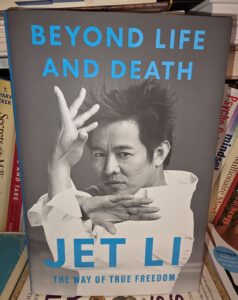
BEYOND LIFE AND DEATH JET LI
Big Idea#1 Compassion
BigIdea#2 “Suffering” is Tongku
Big Idea#3 Searching for #0
Big Idea#4 Renunciation
Big Idea#5 Be a grandson to the world
Big#1 Compassion
I see the spiritual evolution of a martial artist in three stages. In the first stage, I have a sword in my hand and a sword in my heart; in the second, I have no sword in my hand, but still a sword in my heart; and in the third, I have no sword in my hand, no sword in my heart. During the first stage, human skill is at its peak. This is the integration of the fighter with their weapon. The fighter’s skill is so perfect that there’s no difference between the fighter’s arm and the sword because the movements are made with such grace. Even at this stage, it is possible to refrain from killing. When a fighter’s skill is good enough, they can end the battle before dealing death. Still, fighters can use their weapons only to beat someone’s body; they can never use it to change the other person’s heart. If the challengers on either side of a conflict never evolve to the next stage, the first stage can continue for thousands of years. Feeling wounded and bitter, one generation will teach their children to take revenge on the other side, who will in turn react with their own woundedness and bitterness and pass it down to their children.
In the second stage, the sword is not in the hand, but it’s still in the heart. While the warrior is not using the sword to attack, inside they’re still angry. In this stage, the fighter stands strong, and others perceive their strength. Imagine a country with a huge store of arms, missiles and bombs, tanks and soldiers. Everyone knows that if they were to attack this country, they would be damaged in turn. This is the stage of diplomacy. Instead of fighting with weapons, they fight with rhetoric. This is also the stage of protection. People protect their own people and their beliefs. Many diplomats in the United Nations try to do this; sometimes they are successful, sometimes they aren’t. As we read in the news everyday, this is no true peace.
In the third stage, there’s no sword in the hand and no sword in the heart. This is the stage of compassion and universal love. If you love everyone, there is no offense or defense. As it says in the Christian adage, “if you slap me on the cheek, I will offer you the other side.” In the third stage, the martial artist trains the body and mind not for aggression, but to dissolve violence – whether the external violence of physical combat or the internal violence of anger and self-centeredness. In this way, the third stage reflects the deeper meaning behind the term wushu. The term has two characters: wu and shu. Wu is a compound character that contains the meanings “to stop” and “weapon.” Shu is the character for skill. Put together, their meaning becomes “to use martial skill to stop violence.” That is the true skill of wushu and the compassionate depression of the warrior’s awareness that they are connected to all of life.
For years, people have asked me,”Jet, what is the secret to self-defense?” My answer often surprises people: a smile. The smile is emblematic of the third stage of martial arts, over a three-stage process: if you consistently meet aggression and anger with softness and kindness, it will be difficult for anyone to stay mad at you.
Before we can have compassion for others, we need to have self-compassion. If we don’t love ourselves. We can’t love or have compassion for others. We are our own worst enemy. We tell ourselves that we are not good, smart, intelligent, or worthy etc… We would never talk to our best friend like that. We would encourage them, tell them that they are good enough, this is only a temporary setback to make you stronger, you are never given any obstacle that you can’t overcome, this is to make you stronger.
Talk to yourself how you would talk to your best friend. We spend the most time with ourselves. We need to learn to become best friends with ourselves.
Big Idea#2 “Suffering” is Tongku
In Chinese, the word for “suffering” is tongku, composed of two characters: tong means “pain”; ku means “bitterness.” So suffering is pain plus bitterness. Most of the time, people speak of these two characters together: pain-and-bitterness. They speak colloquially about “eating the bitter.” Without realizing it, they mix up the two and don’t see them as separate. But in fact pain and suffering are two distinct phenomena. Everybody knows when you break your arms, it hurts a lot in the moment, and you continue to feel pain for a short time afterward. Then you put it in a sling or a cast, can’t move it for a week, and after a couple of months the arm is healed. There’s a saying in Chinese: “If you break a bone or a ligament, a hundred days and you’re cured.” Unless there is some irregularity, pain is usually short term.
But the bitterness is all the mental processing about the pain. Every time I broke a bone, my mind would react by producing all kinds of thoughts, judgments, and fears. There was all the self-centered thinking: Why am I unlucky? Why do I feel like shit? Why does bad stuff happen to me? Then there was the judgment: Stuipid! Why am I so clumsy? Why do I never learn? Why can’t I do it right? What will happen to my work? Next time I need to be careful. Be careful, be careful. Oh no, I broke it again.
If we try to fight our pain or outsmart it or destroy it, we’re adding bitterness to pain, and the inevitable result is suffering.And if it goes untreated, the bitterness of suffering can follow us everywhere, no matter that our injury was healed long ago. There is no hundred-day limit to suffering. It can accompany us everywhere and creep into every waking moment.
This is how it was for me in the seventies and eighties when I was breaking all those bones in my early career. Pain and bitterness always came together. Although the resilience of my youthful body meant I healed quickly, mental bitterness always followed the physical pain, because I didn’t know how to separate them. I was worried about the effects of the injury on my career and tensed my body against the pain of future damage. As a result, I suffered constantly.
And now, after I have been through many years of injuries and aging, pain is there perhaps more than ever. But many years of Buddhist practice have taught me to view it differently. Even today, my stomach is a problem 10 percent of the time. Every time I feel the discomfort, it prods me, reminds me to study, to do something to help people. It’s like an alarm bell that keeps waking me up to the fragility and impermanence of existence. If I can cure my physical pain, great. But even if I can’t, I feel less bitterness about my pain, so I suffer less. I’ve learned to observe my bitterness and recognize it as the creation of my own mind. If I get injured now, I tell myself, It’s better now than in the future.
Master Shengyen was getting older, and he had many health ailments.
“Your body is in so much pain,” I said. “You need kidney dialysis every week. Isn’t it difficult for you?”
His expression was very calm. He took my hand and said, “Yes, it really hurts, but it’s not bitter in my mind. Pain is a matter of the body, and suffering is a matter of the mind and emotion.”
Often how we relate to pain is a matter of perspective on a deeper level. Once, I was studying with Tai Situ Rinpoche, another great Tibetan Buddhist master, at his monastery in India. He instructed the students present to hold out the thumb of our right hand and focus our attention on it. All of us held out our thumbs like we were giving a positive review: thumbs-up.
“Now, do your best to visualize all the pain and suffering in your life so far – all the loss, grief, hurt, illness, and disappointment. Imagine that all this pain and suffering is concentrated entirely in your right thumb.”
“Now close your eyes and carefully tough your thumb containing all your pain to your right eyelid,” he said. “As you touch, make sure you hold all the painful and unsatisfactory things in your life in our attention. Leave nothing out. You are holding a whole lifetime of pain in your thumb.”
I held my thumb to my eye, evoking my injuries one by one: my broken ankle, my broken knee, my broken nose, placing each memory in turn in my thumb. I thought of the loved ones I had lost, and my professional frustrations, and my loneliness. I put it all in my thumb.
“Now keep your thumb close to your right eye, but open the eye,” he said.
We did as we were instructed. My thumb was enormous, blotting out most of my vision.
“Is everything you see filled with sadness and pain?” Tai Situ Rinpoche asked.
“ Take away your thumb,” he said.
The world around me came rushing back into my sight: my own body, the other students withdrawing their own thumbs, the master, the ornate furnishing of the room.
“Do you realize that the world is still there and still beautiful, even when you couldn’t see? Do you understand that all the misfortune and pain of life are only within the scope of a thumb?”
Tai Situ Rinpoche continued, “All your painful feelings are magnified by your own mind. If you look only at your pain, you won’t be able to perceive the beauty around you. There’s nothing in this life that can’t be changed by a shift in perspective. Most living beings are in pain because they’re staring at their thumb, thinking it’s the whole world.”
When you visualize your mind can’t tell real from fake.
This remind me of Lanny Bassam WITH WINNING IN MIND
Many people are concerned that they cannot seem to get a sharp picture and do not really see clearly when they try to visualize. I don’t think that the clarity matters.
What you see is not important but what you feel. Rehearse the feeling of hitting a good shot. Don’t try to see it. Try to feel it.
It’s about the feeling how it made you feel
An investigation was carried out to evaluate the effect of imagery instructions on a simple motor skill accuracy task (putting a gold ball). Thirty college students were blocked on their putting ability and randomly assigned within blocks to one of three experience mental conditions: (a) positive imagery, (b) negative imagery, and (c) control.
Subjects in the two imagery conditions were given the identical instructions for imagining the backswing and putting stroke. In the positive imagery group, subjects imagined the ball going into the cup, white subjects using negative imagery visualized the ball narrowly missing the cup. Subjects in the control group putted without instructions. On each of 6 consecutive days, a 10-putt trail was conducted for each subject. There was a significant effect on performance improvement. Analyses showed significant differences among all groups, with positive imagery producing the most improvement, the control condition producing less, and negative imagery resulting in performance deterioration.
Not only does positive imagery increase performance but when we think about creating error we improve the chance of error occurring as well. When we worry that bad things might happen to us we are actually rehearsing them. We are building new neural pathways toward failure.
Big Idea#3 Searching for #0
There is a team of ten people sitting in a circle. Everyone’s shirt is marked with a number. I stand up and ask number 1 to my right, “Where is zero?”
He says, “Next to me.”
I go to the next person and ask, “Where is zero?”
He also says, “Next to me.”
I go to the next person, and the next, down the line until number 8, who says, “Two down.”
I walked two down, past number 9, but then I hit number 1 again. I ask number 1 again, “Where is zero?”
He gets impatient and says, “Didn’t I just tell you? Next to me.”
I feel annoyed that all these guys are playing with me. Then I look down. I’m wearing number 0! Because I, frantically searching outside, had never looked down at the simple answer inside myself.
Although, through my studies, I thought I understood what it meant for Budda-nature to be inherent, the words finally settled in me. My fervent external search would inevitably result in suffering. I could become my own boss only by looking within.
“Two percent of the people think; three percent of the people think they think; and ninety-five percent of the people would rather die than think,”
Jim Rohn, a motivational speaker once knew a man. He had been doing self-improvement for 15 years. He read 200 books, attended more than 30 seminars, and more than 50 courses. His life looked the same when he started. The same body , same relationship, same income, same sense of dissatisfaction. He came to Jim Rhon exhausted, frustrated. He said I don’t understand. I’ve done everything they said to do. I read everything they said to read. Why am I still here? Jim Rohn asked him a question. I said in the last 15 years, name one specific habit you maintained without interruption more than 90 days. He thought about it a long time and couldn’t name one despite all the reading, of course he actually never maintained a single behavior change for 90 consecutive days.
That is your problem: you have been studying change not making it and you must understand the distinction before anything else can shift for you. The books and seminar did not lie to you. The books and seminars aren’t the change, doing is the change, and you have done nothing consistently for any length of time that is why you’re still here.
Then he asked what to do. I told him to pick one thing and do it every morning for the next 90 days and in those 90 days you are forbidden from reading another self improvement book. You are forbidden from attending another seminar. You are forbidden from taking another course. The reading stop the doing start. He starts writing 30 min every morning. A year later became a different man. He wrote a draft of a book and lost 20 pounds. The discipline had spread to others without him forcing it. He got promoted at work because the consistency shows how he shows up everywhere else.
He told me the 200 books had done nothing. The single sustain behavior had done everything the change had been waiting on the other side of doing not on the other side of more reading. He spent 15years reading because reading felt like doing. The day he accepted that doing is the only thing that did anything that day his real life started. 15 years he had wasted not because the books were bad but because he treated the books as the work the books were never the work. The work was always the work and the work could only be done by doing every single day in his actual life. What actually works is slow, boring, and repetitive. The real engine of change is one small habit done every single day for years
We want to move from theory to practice to mastery. We don’t want to be library of the mind. We want to be warriors of the mind.
Big Idea#4 Renunciation
Renunciation (naiskramya in Sanskrit) refers to a realization about what can and what cannot bring a person lasting happiness. Material phenomena are characterized by three qualities: unsatisfactoriness, impermanence, and lack of an essential self. This means that by their very nature, these phenomena are unable to provide us with lasting and reliable satisfaction. If we cling to any of them, we will continue to suffer. When we see through to the true nature of things, we see how they can’t provide us with abiding happiness and we become disillusioned with them. Instead, we become animated by the prospect of liberating ourselves from clinging and acting in service of the liberation of others.
Renunciation here doesn’t mean giving up material possessions and living the ascetic lifestyle of a full-time monk. Rather, it means a change in how we relate to our worldly desires, possessions, and self-centered pursuits. Instead of feeling so attached to them that they overshadow our deeper identity, we cultivate an inner sense of equanimity: We’re okay when our lives are going as we want them to, and we’re okay when they’re not.
Whatever we rely on outside of ourselves, that’s our boss. We’re its employees. We give it our energy, time, and intelligence. If we put all our energy into making money, money is our boss; if we put it all into achieving fame, fame is our boss. If we work hard and save all our money so we can buy an Apple Watch, believing the Apple Watch will provide us with lasting happiness, then the watch is our boss. Most of us work in the service of our five senses: We seek pleasure and avoid pain, constantly drawing near and pushing away, chasing and being chased. When this agitated reactivity keeps knocking us off our center of gravity, zizai, the confident contentment of knowing we’re our own boss, is elusive.
If anything outside of ourselves is our boss, we suffer. So often, when we act, we anticipate a particular result. If we get it, we’re certain we’ll be happy; if we don’t, we’re sure we’ll be unhappy. If we anticipate like that, the particular result we cling to is our boss.And it doesn’t stop there. Even if we attain the results we wanted, we immediately move on to the next. Or we don’t get what we want, and our mind seizes on something else or holds on obsessively to the result that got away. We stumble blindly from boss to boss, chasing happiness and never catching it. When something outside of ourselves is our boss, we can’t use our energy to become free or to free others. This is the cycle of suffering. To break the cycle, we must see the skies beyond the sky: Shift our perspective, recognize that any happiness we seek based on transient worldly objects is illusory, and let our cling die to make room for the lasting happiness found within.
When I began studying Buddhism, I learned a way to work with suffering: Act, and let the results come, whatever they may be.
External Vs. Internal motivation
If your primary focus is on External motivation, money, wealth, fame, or hotness. You’re going to be less psychologically stable. If your primary focus is on internal motivation growing personally as a human being, contributing to the community, developing a loving relationship with your family. You’re going to be more psychologically stable.
Big Idea#5 Be a grandson to the world
In the winter of 2004, our family had made plans to go to the Maldives for our vacation. We set off from Hong Kong on Christmas Day, passed through Thailand, and arrived at the Four Seasons in the Maldives that night.I had heard that the islands might gradually be submerged due to rising sea levels, so I wanted to seize the opportunity to visit it while we still had a chance.
On our first morning, my two younger daughters, aged four and one, wanted to play in the ocean. Our babysitter helped them put on their swimsuits, and we all went down to the beach. Standing in the water while my daughters splashed and laughed, I saw huge waves in the distance. I thought, what happened to the sea?
The first wave hit the beach, and the tourists sun bathing on the sand immediately got up, picked up their overturned items, and rushed back to the hotel. The waves came again, and this time the water covered the top of my feet. The water was too high, too fast. My daughters seemed too small, too vulnerable, too easily at the mercy of the gathering waters. My older daughter was still playing in the water, so I picked her up and asked our babysitter to carry my younger daughter while we prepared to go back. I looked back again. There was no beach or hotel. Nothing. I was standing in the ocean.
Another wave hit, and the water reached my hips. I held my daughter in my arms and arduously waded through the water. I took the first step, then the second step. The waves climbed higher and higher. Now the water was waist-deep.
Then a huge wave crashed over us and washed my younger daughter and our babysitter over twenty feet away. The water had scooped up my tiny child and flung her farther into the ocean. I lunged forward, but I could barely move. Dizziness spun my vision and terror chilled my skin.
In anguish, I started crying out, “Help! Help!” gargling seater between shouts.
One more wave, and that’s it, I thought a thought flashed in my mind: Avalokitescaral!I called out to the bodhisattva of compassion, Please, help me face the danger of this situation. If I survive this time, I will change my life.
With total clarity, I was aware that the distance between life and death was only four inches between the rising water and my lips. If another wave comes, my daughter and I will drown. Readying myself to absorb the impact of another battering wave, I planted my feet and gripped my daughter’s knees tightly to keep her from slipping off my shoulders. I kept blinking, but the water bit at my eyes, blurring my sight. I heard the water surging all around me, felt the urgent pull of the tide sliding past my ankles. This is it.
And then the waves stopped surging.
I looked around frantically and saw that the shore had appeared again. Fortunately, when we came to the beach, several staff members from the hotel had come down with us because they wanted to take a photo. When they saw our babysitter get knocked over and carried aways, they rushed into the water and rescued her and my younger daughter. I sloshed through the water toward them and was overcome with gratitude.
Originally, I had hoped to retire at sixty to focus on meditating and volunteering to give back to society and repay it for everything it had given me. At the time of the tsunami, I was forty-one. My awareness of impermanence had crashed over my life with the suddenness of an expected wave. I knew I couldn’t wait until I was sixty.
Humanity is one, and we share the earth as our home. It is all one ecosystem. If each of us does a little, we are all better off. This became my purpose.
After the TSUNAMI, I wanted to start an organization rooted in compassion to help people suffering from natural disasters like the one I had survived.
Gradually, the idea of a foundation that would give everyone an opportunity to do their best for the common good formed. Rather than taking large donations from wealthy philanthropists or corporations, the approach would be to raise small amounts of money from large numbers of participants. Just as the practice of awareness grows by observing one moment at a time, stacking one colored kindergarten block after another, this approach to philanthropy would grow by stacking small donations. Eventually this became expressed in our motto, “One Person, One Yuan a Day.” I shared my inspiration with my wife, and she was supportive.
If no one will listen to me, I thought, I can just walk state by state, city by city, and stand there taking pictures. If you want to take a picture with Jet Li, put 1 yuan in the pot.
I remember visiting Harvard Business School during this time. I wanted to learn their techniques for raising money, so we had a symposium to discuss my project with the world-class fundraising experts on the faculty there. After talking for two hours, the moderators gave me this conclusion: “ You don’t need to learn anything about raising money from Harvard. Youre following a totally different model from anything that’s been done before. Raising money from traditional funding sources and large companies is its own skill. But your belief in what you’re doing is contagious. You share our love with people, and then they will share what they have with others. We’ve never seen this style before.”
It’s like a love transmitted disease
Everybody laughed. Together we refined the language: “Make love go viral”
On April 10, 2007 One Foundation was officially established.
Traveling the world in service of One Foundation, I underwent a significant shift in my identity. When I made my first movie, The Shaolin Temple, I played the lead role. In my film career, I always sat at the summit of the call sheet. Accustomed to receiving preferential treatment, I expected others to cater to my needs above everyone else’s. Now I was humbling myself to learn from institutions and foundations; I was bowing down before everyone I met to recruit volunteers and beg for funds, using my body to cut through my own rules of who I was and what society expected of me. I became the world’s most famous beggar, begging governments, corporations, and individuals to support my idea.
In 2007, I made three movies and devoted almost all my spare time to charity. In February of that year, I spent two weeks ruminating about charity projects until my hair turned gray. One time I drove from Hengdian to Shanghai to attend a publicity event. On the way back, I crumpled from sheer exhaustion and cried in the back of the car.
Is this all worth it? I asked myself.
On May 12, 2008, an earthquake rocked Wenchuan Province in Sichuan. This catastrophe shook half of Asia, the worst in over thirty years. Sixty-nine thousand people lost their lives. One Foundations was able to successfully rally a corps of temporary volunteers to help deliver supplies and carry out its first large-scale disaster relief effort. We accumulated an unprecedented 70 million yuan! This was truly compassion in action.
I became a grandson to the world, the world’s most famous beggar. At this level, my practice did lead me from my small self to my big self, the one who acts for the benefit of all beings.
Jet Li says that the biggest movie of his life was One Foundation.
A news reporter interviewed a twin brother. How did you become so successful and own your own company? Well my father was an alcoholic.
The news reporter interviewed the other brother. How did you become an alcoholic? Well what did you expect? My father was an alcoholic.
The moment we blame we give our power to others. We are telling ourselves that we can’t change our current circumstances.